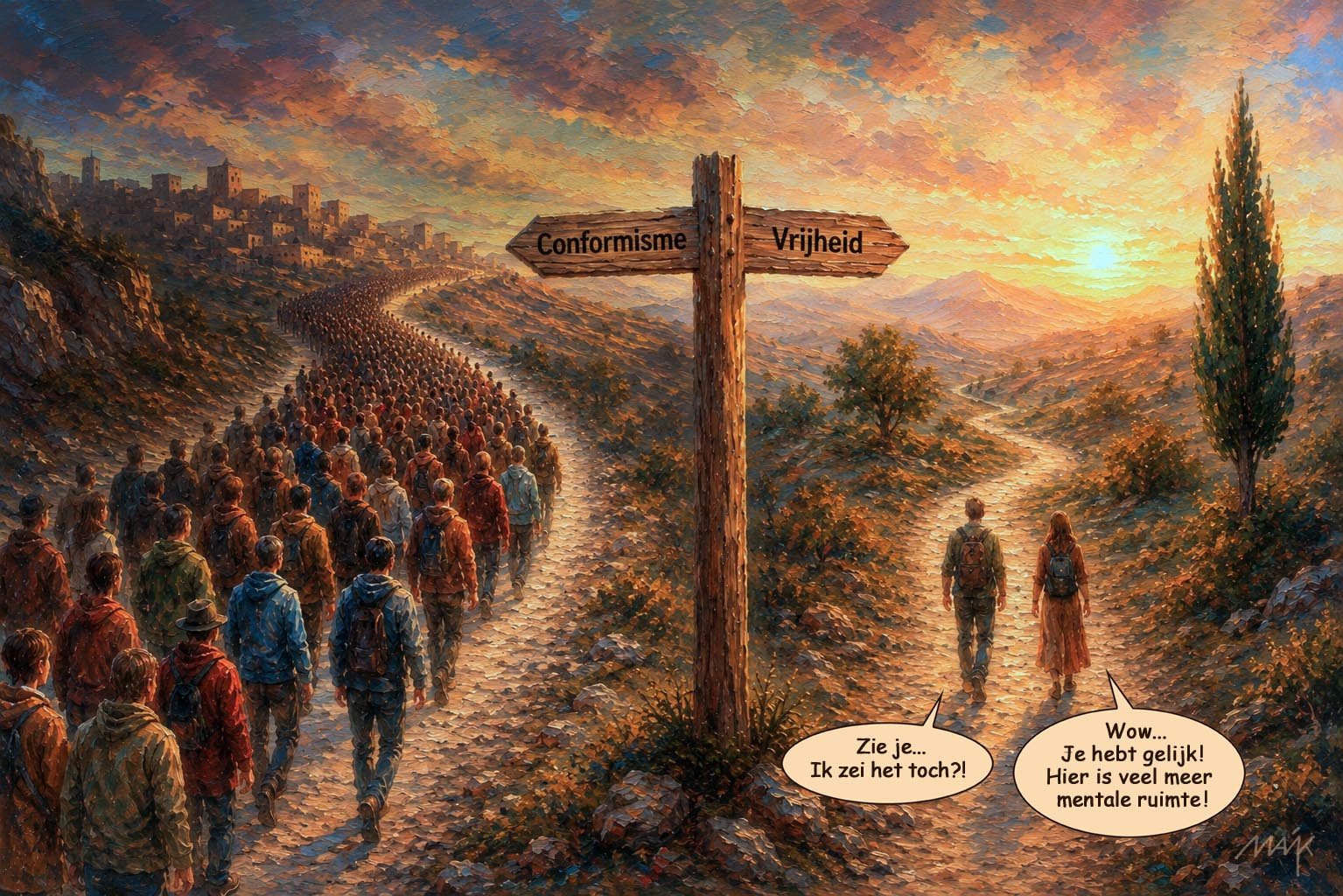
Identification – how identification replaces autonomy
During the FIFA World Cup, we once again witnessed a remarkable phenomenon: connection. Millions of people simultaneously identifying with their country, their team, their flag, and their shared goal. In the Netherlands, houses turned orange, people dressed in orange, faces were painted, and there were caps, horns and all sorts of paraphernalia – it was one big expression of ‘us’. Victory was experienced as a collective triumph, while defeat was felt as a personal loss.
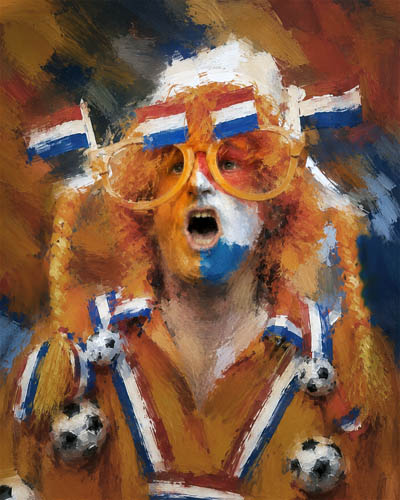 At first glance, such a ‘carnival’ seems harmless and even enjoyable: a brief moment of collective solidarity in which all differences fade into the background. But beneath this shared group experience lies a psychological mechanism that extends far beyond football. For precisely the same thing happens with political convictions, social trends and spiritual movements: identification, the fundamental capacity to connect something outside ourselves so strongly with who we are that we experience it as our own identity. To identify with something is to make it part of your identity, even though it cannot truly be that. The Latin identificāre, derived from idem (‘the same’) and facere (‘to make’), means ‘to make the same’. In Vedic philosophy, this is called Ahamkara.
The philosophy of the Fourth Way, as described by Gurdjieff and Ouspensky, identified identification as a debilitating mechanism through which people lose themselves in thoughts, emotions, objects or situations. This leads to a form of cognitive decline in which you lose the ability to look objectively and self-reflectively at yourself and the world around you. In this way, you create your own ‘preferred reality’, to which others are expected to conform.
Collective identifications arise when people become deeply involved on a mass scale with current issues or ideals. The World Cup is a familiar and relatively harmless example. But this same mechanism can lead to social polarisation, groupthink and a loss of both common sense and sound judgement. Collective identifications inevitably give rise to opposing camps.
To identify with something is to make it part of your identity
even though this is fundamentally impossible
Identification often begins with innocent interest. Once you identify with something, whether through sympathy or antipathy, you surrender your intellectual independence to some extent; you lose a measure of autonomy and inner freedom. You are no longer an objective observer, but become coloured by whatever you identify with. A cognitive bias emerges. Every unconscious and unrecognised identification can close us off and set us against others.
The question, therefore, is not merely why people allow themselves to be swept along collectively, but something more fundamental: why does a human being identify with anything outside themselves in the first place? How is it that we fail even to notice our own identification? We see it everywhere, because everyone gets caught up in collective identification from time to time. The mechanism itself makes no distinction between beliefs. It applies equally to XR activists gluing themselves to roads and to so-called ‘awakened ones’ who endlessly circulate their ideas through podcasts and discussion programmes. Psychologically coloured versions of reality, experienced as self-evident or as truth, are fiercely defended. Refusing to go along with this requires courage, because sometimes you risk being excluded.
Observing this mechanism is therefore important. Unconscious identification that limits us can only be broken through recognising it, seeing it at the very moment it occurs. But first you have to become aware of it – or, as a Dutch football philosopher once aptly put it, you have to ‘get it through your thick skull’. This is something that can be tested. Anyone can investigate it for themselves by carefully observing, over the course of a single day (or preferably several days), how often the feeling of ‘I’ automatically attaches itself to an opinion, emotion, role or group identity. Anyone who investigates this without preconceptions and observes consciously will discover that identification is not an exception, but a normal state of our mind.
Herd Behaviour
Although psychology, sociology and philosophy offer various explanations for large-scale group behaviour, this fundamental mechanism of identification remains largely overlooked. These explanations do describe important aspects of collectivism (within ideologies and all kinds of ‘-isms’), but they focus on the circumstances in which it arises. Yet influence and herd behaviour can only truly gain a hold over us through that deeper psychological capacity to identify ourselves with just about anything. Collective identifications stand in the way of a more conscious (enlightened) society.
This is insufficiently recognised in contemporary psychology. As long as this mechanism is not acknowledged as fundamental, modern psychology will remain insufficiently equipped to understand and influence the deeper dynamics behind social unrest, polarisation and societal disruption. And yes… many modern clinical conditions (genuine illnesses) also stem from extremely powerful identifications that have become deeply entrenched in both mind and body.
The mechanism of identification is timeless
only the ‘what’ changes
The mechanism of identification is always and eternally the same; only the ‘what’ changes. Major social issues are particularly suited to this, because they evoke strong emotions, making it easy to become caught up in them. This is clearly visible in the gender debate. Increasingly popular non-binary gender identities are no longer seen as something one might reflect upon, but instead people become completely fused with them. An idealised construct and the person become one. Trans people even undergo physical ‘alterations’ to their bodies. Any critical questioning of such an imaginary construct is immediately experienced as an attack on the person themselves. People have lost the ability to see beyond the concept, both in themselves and in others.
War is perhaps the clearest example of mass identification, because entire populations go along with a government narrative of good versus evil. Politics and the media almost invariably reinforce a dominant image of the enemy. Once this becomes strong enough, an entire nation’s capacity for independent judgement can evaporate, to the point where even the commission of war crimes and genocide is justified as though it were nothing out of the ordinary. Collective identification thus leads to collective delusion and may well constitute one of the greatest obstacles to human development.
Social media amplify this process. Algorithms are largely designed to provoke strong emotions such as anger and indignation, continuously feeding identifications based on gut feelings. But even well-intentioned actions can unintentionally contribute to further polarisation. On X, for example, people often respond not from a position of independent thinking, but from within narratives that are constantly repeated. The stronger the identification, the smaller the capacity to post thoughtful and sensible responses.
Advertising, media and marketing constantly exploit this tendency. They have long since stopped merely selling products or ideas; instead, they encourage consumers to embrace an entire identity. To be ‘special’. This is also how all those social media influencers who have turned their online presence into lucrative business models came into being. The larger the group identifying with a brand, lifestyle or ideology, the greater the economic influence and profit.
The crucial question is: how can all this happen without us even noticing it ourselves?
Buffers
Within Fourth Way philosophy, this is explained through the concept of ‘buffers’. The human mind does not naturally possess a harmonious unity; rather, it is full of beliefs, emotions and desires that may unknowingly contradict one another. So-called buffers ensure that these contradictions go unnoticed and are not experienced simultaneously. A buffer functions like a kind of firewall, strictly separating different viewpoints from one another. As a result, people can identify with contradictory things in different situations without experiencing any inner conflict. For example, strongly advocating inclusion while simultaneously excluding those who think differently. Because this contradiction goes unnoticed, one’s self-image remains intact. Another example: a supposedly conscious, environmentally minded social reformer and human rights activist, driving an electric car, can continue to justify their environmentally damaging and labour-exploitation-promoting version of ‘sustainability’ without recognising the paradox, let alone examining it. Like shock absorbers, mental buffers thus prevent cognitive dissonance and protect our self-image.
Perhaps the most debilitating form of unconscious identification is identifying with the idea that we ourselves are not identified. This allows us to maintain the conviction that we are conscious, that we think and act freely and independently, ultimately protecting the illusion of ‘free will’.
True freedom therefore begins with recognising identification through self-reflection as soon as it occurs. Only when we see how and with what we are constantly and unknowingly engaging can we begin to stop automatically ‘logging in’ to it. Then we can genuinely pursue the truth and consciously choose what we identify with.
Fortunately, we also possess a faculty of discernment that functions increasingly well as we become more self-reflective. This faculty of discernment has not only an intellectual but also an emotional expression. Just as our intellect distinguishes between truth and falsehood, between what is valuable and what is not, our conscience makes the same distinction through feeling. Conscience is therefore the emotional component of our faculty of discernment. In moments of self-reflection, our conscience intuitively senses when our convictions do not accord with what we know deep down; when we are not entirely honest or when our actions deviate from our own values. This awareness can be confronting. Nevertheless, my position is that our conscience is always right. That is precisely why we would do well to listen to it and always act accordingly. In this way, that inner contradiction dissolves.
Essential Identification
However, the coin of identification has two sides. There is also a positive form of identification, which occurs much more intuitively and is entered into only consciously: it connects us with others and with the world, and can trigger sudden ‘pop-ups’ of intense love and involvement in our minds. I call this essential identification, because it arises from our essence. What is interesting is that such an experience is both real and transient. The love or involvement we experience at that moment is entirely genuine, but the identification that evokes it depends on a particular ‘encounter’. It can inspire us to want the very best for others and to act accordingly. In its most far-reaching form, we find this reflected in the bodhisattva ideal within Mahayana Buddhism. A bodhisattva is someone who chooses to help others attain enlightenment and vows not to enter nirvana (the ultimate state of liberation) fully themselves until all sentient beings have been freed from suffering. It is a form of profound altruistic identification with the fate of others. There are several other examples of this. However, this form of identification remains rare, because it depends entirely on the extent to which we are willing to truly experience another person as ourselves.
The very same mechanism (Ahamkara) that makes us susceptible to peer pressure, convictions and herd behaviour can therefore also be a source of connectedness, compassion and altruism. The difference does not lie in the capacity for identification itself, but in the degree of awareness with which it takes place. Unconscious identification diminishes us because we lose ourselves in whatever we identify with. Conscious identification expands us because it enables us to connect with the whole.
The above article was published in Spiegelbeeld magazine, September 2026