The Meaning of Pentecost
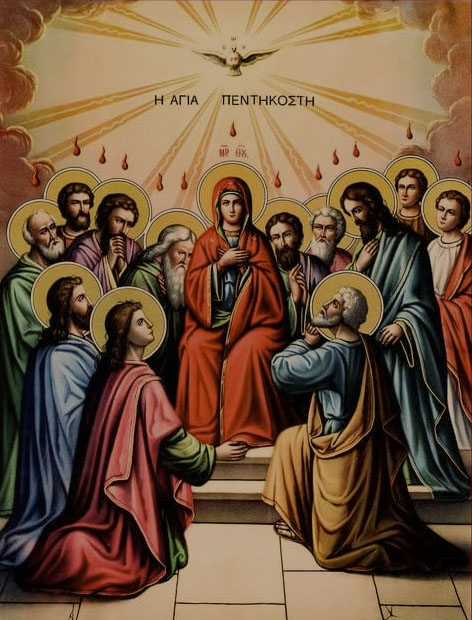 At Pentecost, we celebrate the coming of the Holy Spirit. The apostles were suddenly filled with a powerful, divine energy. This moment was made visible through “tongues of fire,” small flames that appeared above their heads. These flames symbolize inner illumination, inspiration, and the courage to spread the message of love and truth. “Pentecost” comes from the Greek word pentikostí, meaning fiftieth, because it takes place on the fiftieth day after Easter.
The period between the Ascension and Pentecost is an “in-between time” in which Jesus’ disciples no longer rely on something they can physically perceive, but are oriented toward a fulfillment they sense will take place, without knowing exactly how. Oriented toward something that will transform their lives from within.
Psychologically, we can view the period between the Ascension and Pentecost as a transitional phase: a time when old certainties fall away, while the new has not yet taken shape. The apostles found themselves, as it were, ‘between two worlds’. Jesus was no longer present, but they had not yet experienced his Christ-power within themselves. They were thrown back completely upon themselves. Jesus had indeed told his disciples that they would not be left alone and that ‘something’ would come to help them (as described in the Acts of the Apostles – Luke). Yet, after his departure, they experienced a deep sense of loss and discontinuity. At the same time, hope and expectation remained, nourished by Jesus’ promise that they would be ‘baptized with the Holy Spirit’. This promised an inner breakthrough of consciousness and power, which would only become possible when their old anchor, the physical presence of their teacher, was released.
This expectation culminated in the climax of Pentecost. The sudden and intense experience – symbolized by wind and fire – was a major breakthrough of new insight and inner strength. What had already been developing in a dormant state suddenly became manifest through a collective experience of inspiration, courage, and the ability to express oneself completely freely. They could also suddenly ‘speak in many languages’.
We can view this receiving of the Holy Spirit as an ultimate power that enables us to recognize our calling / life path and prompts us to follow it without reservation. Pentecost is therefore a metaphor for receiving the ‘Holy Fire’ of spiritual growth, and we must not only be open to this but also work towards it in our spiritual work, otherwise nothing will change at all.
Spiritual Awakening and Enlightenment
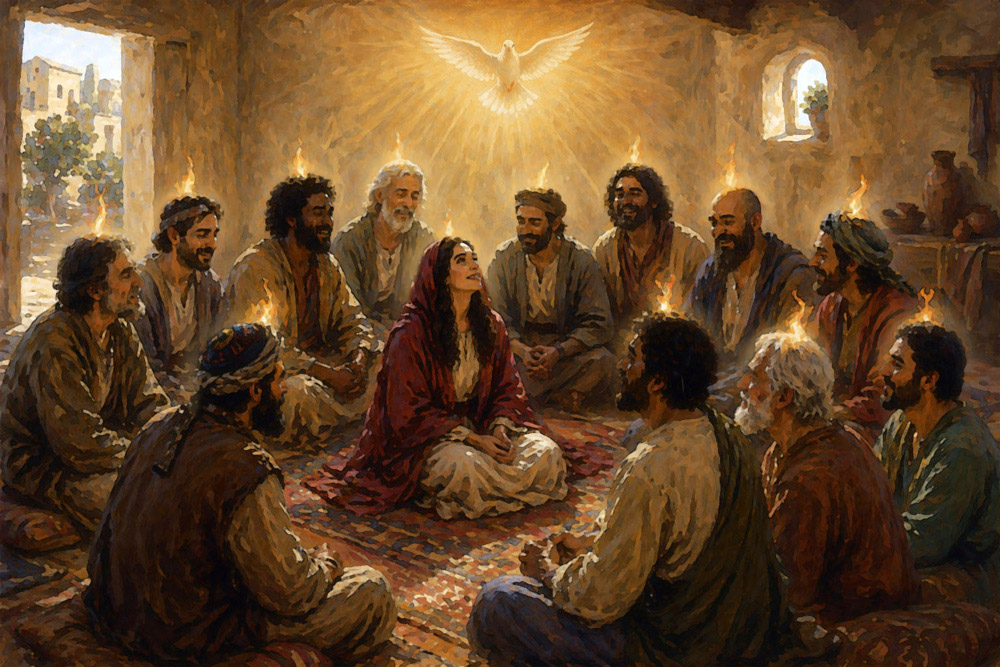 Esoterically, Pentecost stands for inner transformation and symbolizes the transformation of our soul, whereby we attain the highest spiritual truths and insights that we normally ‘cannot reach’ and which take root permanently. It is the result of a process of inner alchemy: lower aspects of our human spirit fall away or transform into higher spiritual qualities. A leaden state of mind transforms into a golden state of mind. This more modernly designed Pentecost icon shows that this is very joyful!
The followers of Jesus became able to speak and communicate in “different languages,” from a universal consciousness and unity. This is the ability to look beyond the limitations of individual differences (cultures) and recognize the underlying unity of all people and all things, allowing everyone to “understand” them. This element of the Pentecost story shows the transition from closedness to open communication, from speaking within one’s own circle to speaking in a way that reaches the world. So not so much that they suddenly knew all languages, but that they finally had something to say that everyone could understand.
Pentecost can also be seen as a step on the path of initiation, in which a person reaches a higher level of spiritual development and consciousness—an initiation into higher spiritual truths that are normally beyond our reach.
Pentecost in Our Modern Time
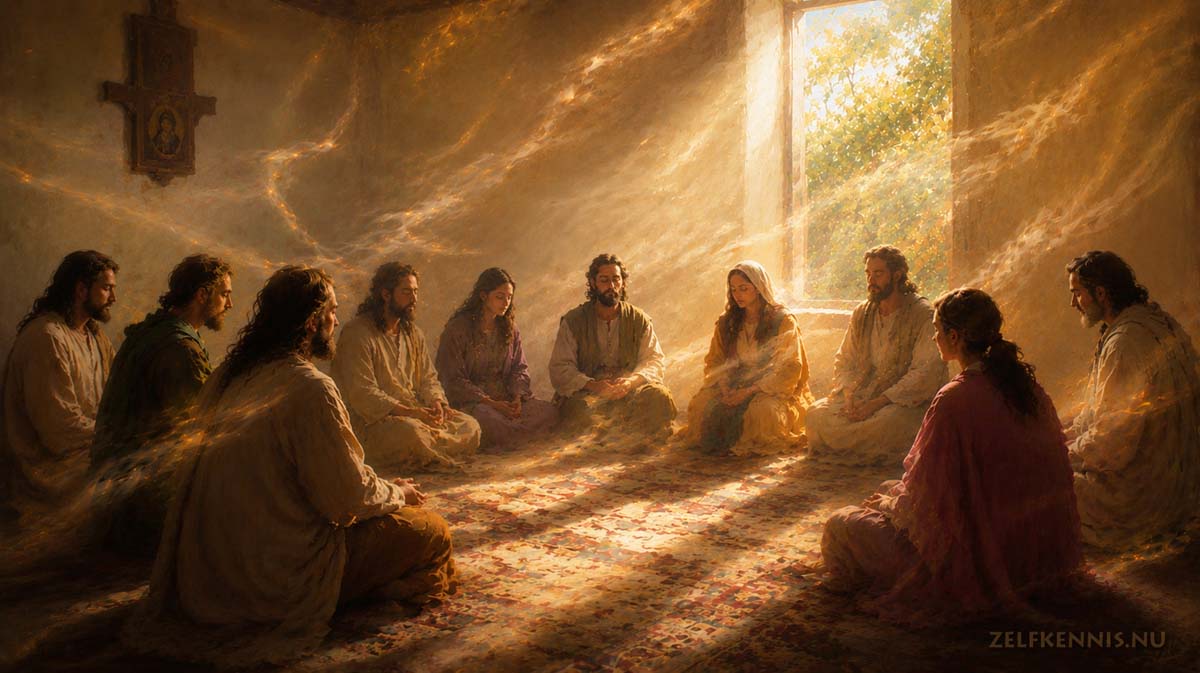
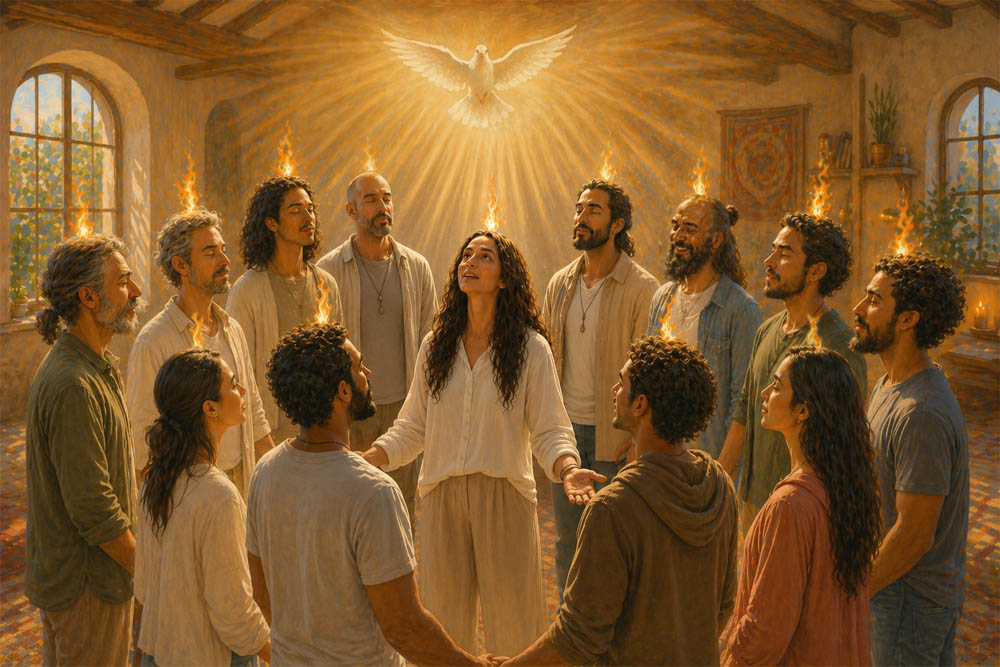 Let us now take a look at this even more modern Pentecost icon. Here we see a group of contemporary people experiencing the Pentecost event: a shared Consciousness that came upon them like fire, resulting in a liberated state of mind no longer constrained by doubt, fear, and separation, arising from a sudden absence of a teacher. In this way, they transcended discipleship and, at that moment, became teachers who would continue the Work and begin to build a spiritual community. This is hopeful, and it is this meaning of Pentecost that we must carry forward. Many people do wish to liberate themselves inwardly by transcending pettiness, but they have yet to find and learn to receive that holy fire.
How can we concretely recognize and approach that “holy fire” in our own lives? How can we realize it? The disciples did this by entering into ‘satsang’ together—with meditation and prayer, as it was called then—by contemplating deeply what had actually taken place during the ‘resurrection’ and ‘ascension’. They turned ‘inward’, for there was no longer an ‘outside with their teacher’. They realized that they had to realize the Christ power within themselves. They did this in an ‘upper room’ (in a hyperōon, a quiet space for higher matters), because Jesus’ disappearance created a great necessity to attain true consciousness. They came to surrender and acceptance of their new situation. Through their collective, dedicated discipline, they attained the highest Insight and, with it, an inner anchoring that overcame every narrow-mindedness within them. They ‘realized’ themselves through collective effort and very profound collective contemplation. Better: they made themselves Real.
Self-realization is the actualization of the Self within us: the entry into what Jesus called the Kingdom of Heaven as the highest inner reality of consciousness.
That is why Pentecost is the most important feast for seekers of truth. Yet this is hardly understood anymore, not even by those who claim to live spiritually. Therefore, this feast of liberation and realization must be restored to its rightful place.
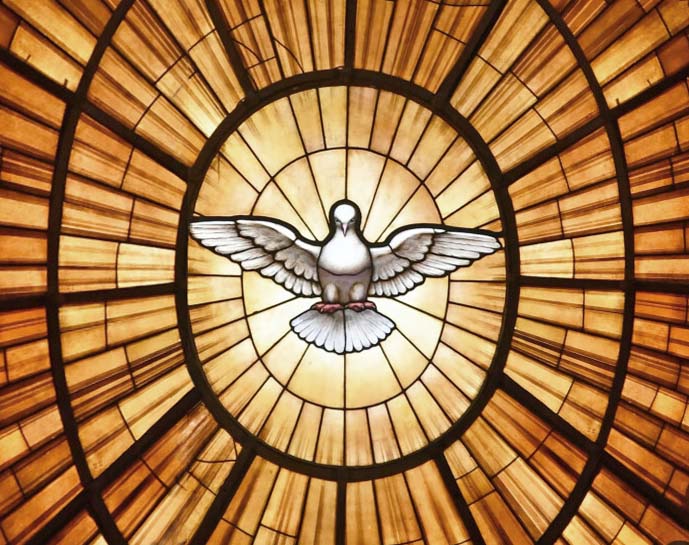
The Dove on the Pentecost Icons
There is a strong similarity between the dove of the Holy Spirit and the Peace Dove. The dove was already a symbol of peace and reconciliation in the Old Testament. When Noah sent out a dove after the flood and it returned with an olive branch, this represented hope and a new beginning after a long period of misery.
In the New Testament, the Holy Spirit appears as a dove at the baptism of Jesus.
Both doves share the same core qualities: purity, gentleness, innocence, and inner peace.
Over the centuries, the two doves have merged in tradition and art. The dove with the olive branch was used both as a sign of world peace and of the Holy Spirit.
But what does peace mean individually?
In the icons of Pentecost, the dove is consistently present because Pentecost is the feast on which the Holy Spirit itself descends upon the apostles. It is therefore directly related to the situation at Jesus’ baptism, where the Spirit descended visibly as a dove. That same dove of gentle, pure, and peace-bringing spiritual power is now poured out at Pentecost over the community of Jesus’ followers, whether secular or not.
That is why Pentecost is the most important feast for truth seekers and peace activists. But this is no longer understood by virtually anyone. Not even by people who claim to live a spiritual life. Therefore, this feast of liberation and realization must be restored to its rightful honor.
Mary Magdalene
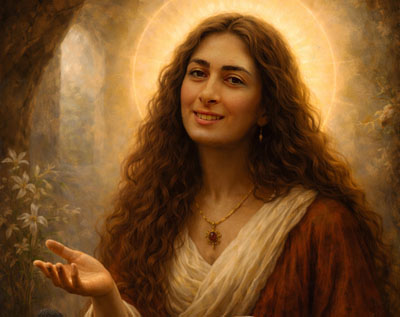 On the original icons, a holy woman is always depicted at the center. This raises the question: is this central woman Mary Magdalene?
That is probably not the case. As the Holy Pentikostí, the central woman possesses the characteristics seen on many icons. But… why we cannot recognize her as Mary Magdalene? That would be quite possible. After Mary Magdalene had a confrontation with the conservative Peter, she spoke as Apostola Apostolorum with many followers of Jesus about very profound matters. In some early Christian texts (outside the official canon, therefore), Mary Magdalene possesses very deep insight and, as a result, a special bond with Jesus. She has the right to stand centrally on such an icon.
The Gospel of Mary states that after the resurrection and ascension of Jesus, she shared spiritual insights with the other disciples, and that Peter was not immediately comfortable with this, for she was, after all, ‘just a woman’… Whether it is historically accurate that she stands at the center of the icon is less important than what it symbolically depicts. In this modern interpretation, she is not a passive figure, but a conscious, perhaps even leading, person. That makes the image stronger. Seeing her in the center like this also changes the dynamics of the group. Less hierarchical and together in a shared group consciousness.
Pentecost does not represent a closed historical moment, but a state of consciousness that can be realized again and again wherever people come together—in groups or communities—when truly collective and profound Work is undertaken. There is not one teacher standing above the rest; rather, a collective field of consciousness arises in which insight circulates and deepens. This also makes the role of someone like Mary Magdalene within this group so meaningful: they were pioneers of an inner transition that is possible for everyone in this time.
Holy Fire
(Pitch for NATO-(S)top Demonstration The Hague)
“To move freely, you need technique,” Johan Cruyff once said. This also applies to ‘remaining free in peace.’
To remain peaceful in every situation we encounter, we need technique. You develop this technique of ‘moving freely’ inwardly (and continuing to do so) by dedicating yourself to it 24/7.
This is important, because when we are confronted with resistance or aggression, a peace-loving mindset is often not enough to preserve our inner peace. Then it becomes clear that we lack the practical experience that allows us to “move freely,” and on autopilot we fail to respond peacefully. We lose that mindset of peace and tolerance. Moreover, putting on a “peaceful poker face” drives us even further away from true peace and leads to a loss of connection with others.
It is important to become aware of this and to train ourselves in being peacefully free, regardless of whom or what we encounter. Many tools exist for this.
Perhaps you may think: what does that church festival recently, Pentecost, have to do with us… with peace, with demonstrations, with the struggle against war, against injustice, against lies and deception? But then I tell you: Pentecost is the festival of inner liberation and peace. Not of belief as a system, but of the human spirit as a spiritual fórce! Symbolized by that dove!
In the ancient stories it is said that the Spirit descended. Like a gust of wind, like flames, like a sudden ignition of truth in the hearts of people. Not upon a few selected individuals, not upon a holy elite, but upon all who were willing to listen, to become still, to turn inward. Upon everyone who let go of their fear and began to speak their truth.
That Spirit is a source of fire within us that does not burn, but illuminates. It is a force that needs no violence to change the world, because it speaks from within: through love, through clarity, and through courage. And if this fire burns anything away, then it is lies and fear.
People are once again demonstrating for peace… in cities, on streets, at institutional buildings, in silence or with words, with drums and banners.
But true peace does not begin with politics. Not with treaties. Not with “ban the weapons”…
Peace begins with Spirit… holy Spirit!
Peace begins with people who allow themselves to be inspired no longer by hatred or ideology, but by something far deeper:
By Spirit that is peace, that is truth, that is wisdom, that is fearless. Peace knows no opposition! So if you feel opposition toward you as a person with your vision? Then get to Work!
The dove of Pentecost, and also that of the peace movement, is not some sweet little symbol of well-meaning hope. It is the inspiring image of a human being who has awakened. Of every human being who says:
“I am not powerless. I am a bearer of light”
“I am not alone. I am part of a greater fire that will now ignite upon the Earth”
That is why the holy fire of Pentecost belongs to the peace-loving and the seekers of truth. To everyone who does not merely demand peace from the world, but wishes to embody it in word and deed. Outside themselves and within themselves.
Not tomorrow
Now
Every single day again