
Michiel Koperdraat
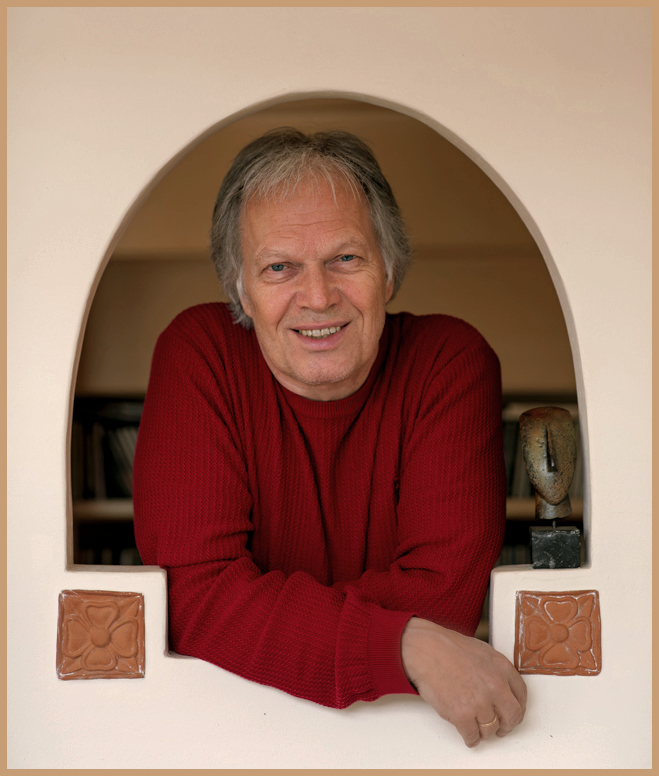 Michiel Koperdraat (1956) is a musician, music teacher, and coach. In addition, he is a philosopher and likes to share his insights and experiences in the area of personal inner development. On this website, he writes about this, because he does not write a book, but a website.
Michiel Koperdraat tells:
“Practical spiritual philosophy is my great love, and I enjoy stimulating the desire for self-awareness and inner development in both myself and others. This aspect also receives attention in music lessons and workshops, as mental barriers have a profound effect on musical practice and group dynamics. A lack of inner anchoring means that musicians sometimes can’t fully harness their talents, preventing them from fully flourishing musically. This, in my opinion, applies not just to musicians. I always encourage self-reflection and self-observation while working with people. I’m convinced that we can only truly deepen our thinking, feeling, and actions (whatever they may be) when we get to know our true selves.
Attention
As a musician, I’m mostly self-taught. I taught myself to play various instruments and to sing, mainly by attentively listening to others, imitating their artistry, focusing on minute details, and then building on this foundation through improvisation and exploration. Improvisation is my primary source of inspiration and talent because everything that comes to my musical mind during practice, playing, and composing originates from Absolute Consciousness. I don’t feel that the ideas and music that come to me are ‘mine’. I didn’t ‘think them up’. They just appear, provided to me as a means to thrive in my life. Complete attention ensures that everything ‘necessary’ comes through and is ‘immediately available’ when needed. Without this total focus, I’ve found that the music can become mechanical, accompanied by various distracting mental side effects. In my view, this principle applies to everyone, in every profession, and in every action.
Flourish
As a musician, my job revolves around playing. But even as a spiritual philosopher, I am playing. This should be the case for every profession or activity because life is a playground where we can flourish. Truly playing removes any stress and pretension from any action. This leads to a game that is enjoyable to watch. Results then naturally reflect this play.
My interest in practical spiritual philosophy was sparked at a young age after being introduced to P.D. Ouspensky’s Fourth Way book ‘Man and his Possible Evolution’. Ever since, I’ve been searching (and still search) for the essence of inner development. Later, I found similar values in Vedic philosophy, especially those aspects that I could directly practice and which encourage further development and inner liberation. A significant insight I gained early on was from the teachings of Gurdjieff and Ouspensky: the necessity of self-remembrance. Incorporating this into my daily life became vitally important to me.
I pursued a practical philosophy study (School of Practical Philosophy, Amsterdam, and Groningen) and taught study groups there for several years.
 I studied philosophy for many years at the School for Practical Philosophy and Spirituality, first in Amsterdam and later in Groningen, and in Groningen I taught for many years as a tutor to the beginning study groups (before they underwent their initiation). At this School, I became a tutor before my own initiation took place, which is highly exceptional. This was made possible by the practical experience and subject-matter knowledge I brought with me upon entering the School.
Autognost
Most of the time, I feel like an ‘autognost’. Similar to my experience in music, everything of vital importance seems to come to me naturally (as if from the Self) when I am in a state of complete attention. All wisdom resides in our consciousness as soon as we create space for it in Silence, directing our attention towards it, and are thus receptive.
In my interactive lectures, I start with crystal-clear principles that provide a clear and understandable picture of how our mind works. This arrangement lays out our potential and often self-imposed limitations. This setup allows us to communicate about inner development, which is the same as inner liberation, without much confusion. Liberation through ‘autognosis’ because, in essence, everyone is their own life coach through acquiring self-knowledge. Everyone is heartily welcome.”

© Michiel Koperdraat
Description Podcast of Hope – April 6, 2025
Michiel Koperdraat is a versatile musician, composer, and arranger who has been active since the 1970s in a wide range of musical styles, from progressive rock to Greek music. As the founder and coordinator of Ano Kato, he brings his passion for Greek music to life through concerts, workshops, and educational projects. In addition, he is active as a philosophical coach and teacher, guiding people in self-knowledge and spiritual growth.
In this podcast, Michiel Koperdraat explains that happiness revolves around inner freedom and letting go of old conditioning. He clarifies that enlightenment does not mean becoming some kind of guru, but rather that you have become inwardly free, unburdened by old baggage. Developing a ‘bullshit detector’ helps in this process, allowing you to recognize falsehoods not only in others, but also within yourself.
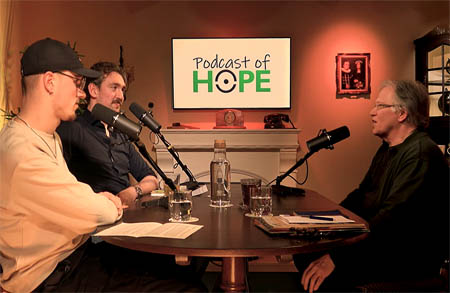 The conversation continues with the importance of self-expression. Michiel emphasizes that everyone comes into the world with a certain individual essence, with innate talents and limitations. Self-expression is the way in which you allow that essence to unfold, whether through art, work, or other activities. However, true freedom within self-expression always has boundaries. According to Michiel, it is precisely within these limitations that mastery reveals itself. The idea of total freedom is an illusion; freedom is always embedded within limits.
He then delves deeper into the concept of self-reflection and self-remembering. Michiel explains that through the ‘metapsyche’, a silent observer or witness, you are able not only to experience yourself but also to observe yourself. This state of mind makes it possible to see yourself in every moment and, if necessary, correct yourself—not only afterward. Self-reflection helps you detach from the ego, which arises purely from identifications with roles, possessions, and ideas. Letting go does not happen through force, but through the insight that you can never be what you perceive.
Michiel also shares practical exercises to live more consciously, such as meeting people without prejudice and truly seeing them. He emphasizes that happiness is ultimately a choice—provided you become aware of who you truly are, beyond learned roles and identifications. Click here if you are interested in practical exercises for self-reflection.

