Suffering in the Easter Story
In the way the Christian Easter story has been portrayed over the centuries, the formation of the imposed suffering narrative can be clearly observed. In the music of Johann Sebastian Bach, the St Matthew Passion, the suffering of Jesus is magnified to the extreme and made all-determining. And what did Bach do? He stopped composing at the crucifixion. The resurrection, the victory over ‘death’, in other words the transition of Jesus into ‘the Christ’, was not set to music by him. This can be called curious.
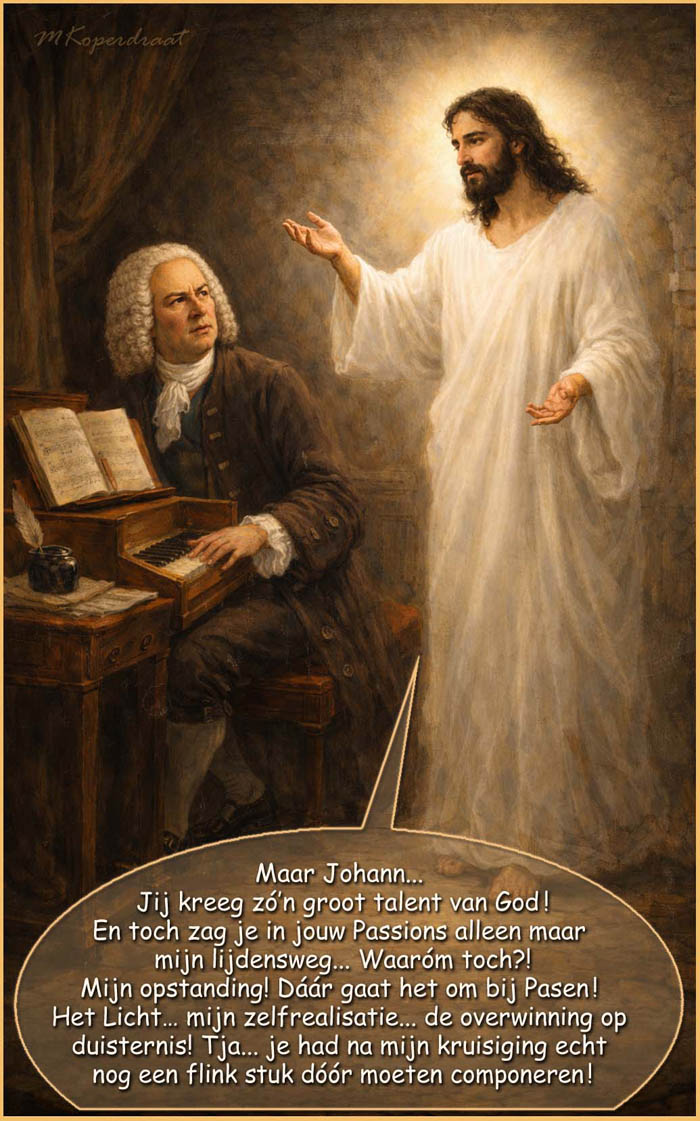 Alright, Bach composed his masterpiece for the Vespers service on Good Friday, to reflect on the suffering of Christ. The theological and liturgical focus is therefore solely on the suffering of Jesus and on the crucifixion and burial. Bach literally follows chapters 26 and 27 of the Gospel according to Matthew, which ends with the sealing of the tomb by Joseph of Arimathea. The resurrection, which is only celebrated at Easter, is therefore not addressed. The Passion ends with the chorale “Wir setzen uns mit Tränen nieder“, which symbolizes the mourning and resignation of the followers. It leaves the listener in a state of devout sorrow.
Many therefore ‘sit down in tears’ while listening to this Passion and are left afterward in a kind of sacred-feeling depression. The Light of Easter, the resurrection that would dispel this sorrow like a flood of lived ‘water of truth’ (see text in box), is not ignited at any moment.
The feast of Easter, which in our own individual experience should also revolve around resurrection and enlightenment through transformation, is celebrated by almost no one in that sense, other than by searching for eggs and enjoying good food with family. This Christ-transformation is the essence of the Easter story, but also in our own lives. By increasingly gaining strength in letting go of our identifications with suffering, it can be overcome. That this is ultimately very difficult—as the final step in the developmental octave that a human being goes through—is described in the Gospel of Peter, in which Jesus on the cross cries out: “My power, my power, you have left me.” Jesus cries this instead of the desperate exclamation that God would have abandoned him, which can be read in the canonical gospels.
This is what has occupied me for a long time. How a simple message of inner liberation could become covered by layers of power and repression. How the conscious and living core of resurrection and liberation has become enclosed within a completely unconscious and ‘dead’ gilded construction. My father once depicted this in a painting titled “Christ and His Representative on Earth”.
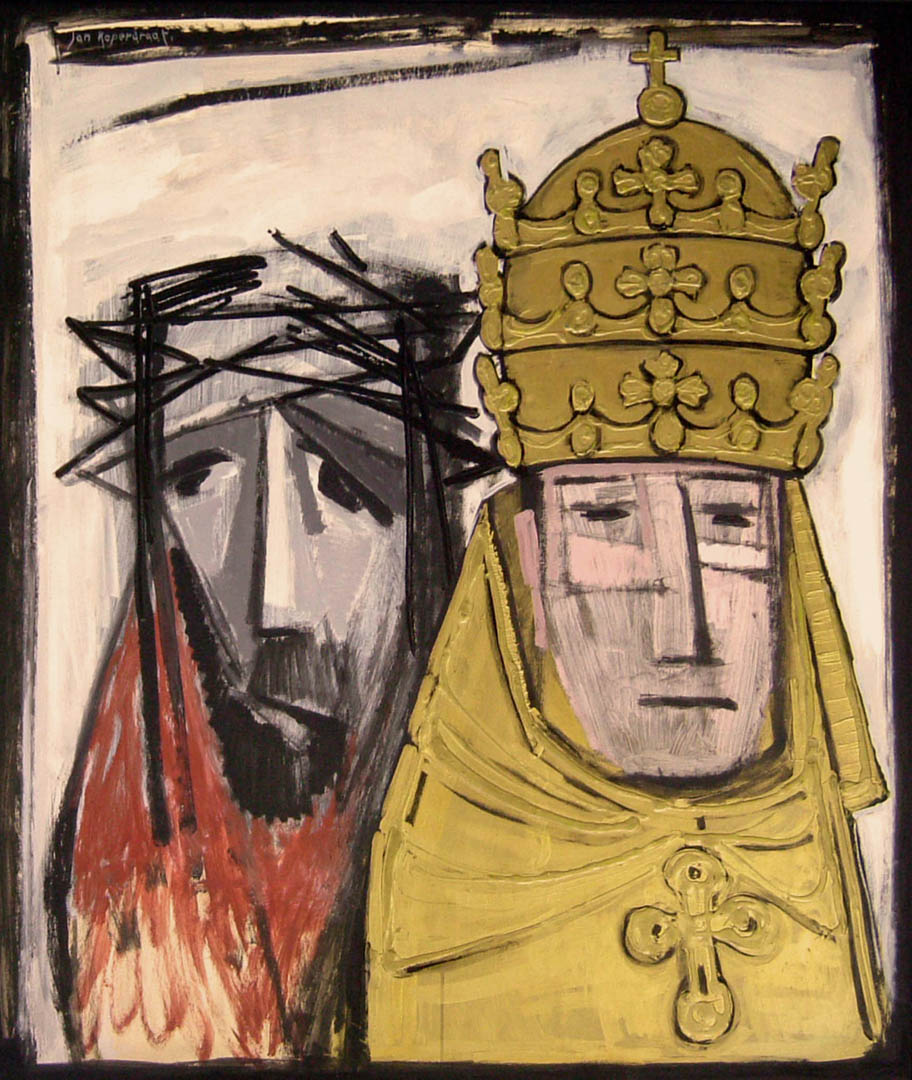 On the left, the Christ figure: sober, marked, almost withdrawn into himself. On the right, the representative of the church: heavily crowned, clothed in gold, radiating distant authority. Between these two figures, there is no resemblance whatsoever. Liberation from within became authority from above, which for many years was even enforced with great violence. A complete reversal of what the Bible was intended to be as a guide to inner liberation. Realized through a total lack of understanding by people who do not comprehend why a human being must liberate themselves inwardly.
Not only in music or art, but in the entire way of looking, it was already firmly established in Bach’s time that suffering had to be central. Liberation, resurrection, or transformation had already completely receded into the background. Throughout those centuries, church leaders and the liturgy determined how the story should be read. Church leaders were effectively the government at the time. Other perspectives, such as inner or gnostic ways of viewing, were suppressed already in the first centuries after Christ. This has had major consequences. When you fix living, liberating insights into a single, fixed governmental narrative, it becomes something entirely different. It becomes a system. And within a system, it is no longer about liberation, but about obedience to form.
We see this not only in religion. We also see it in political and ideological systems of today: as soon as a truth is fixed as a narrative, it is used to keep people within a certain framework, pushing free, living, and deeper insights into the background.

The city Leiden was once besieged to the very core of its existence, with starvation and despair tormenting its inhabitants. It was unbearable. There was intense suffering! Liberation came when the people themselves breached the dikes and a flood of water inundated the land, initially seeming to threaten the city. Yet it was precisely this that enabled the fleet of the Sea Beggars to reach the city and drive away the besiegers. What first appeared to be a threat turned out to be the path to liberation.
In a similar way, one could say that our human mind is also besieged—not by oppressors from outside, but by inner tormentors: relentless streams of negative feelings and thoughts, and deeply ingrained conditionings. Old traumas and painful experiences, especially those formed in youth, lie at the root of this. So not a siege from the outside. Although… sometimes also from outside, as suffering is often justified in conventional views. In this way, an inner ‘city’ arises called Suffering. This Suffering, too, must be relieved.
In this metaphor, the water can be seen as a flood of truth. Something must be breached. In biblical philosophy, water symbolizes truth that is lived by, in which the psyche is no longer determined and limited by mechanical thinking and conditioning. It calls for a Observer, who places every pain that is experienced (whatever its cause) in the light of Wisdom gained through the inner discipline required by spiritual developmental philosophy.
The pain itself does not besiege the mind, to remain within this metaphor, but the identification with it from the ignorant psyche. This identification with pain composes the story of a ‘poor me’ that even seems to cling to painful experiences. It is not that pain will disappear when one stops identifying with it—more is required for that—but the identification that causes suffering dissolves. Our own Relief of Suffering begins when essential knowledge of truth ‘breaks through’ and starts to dissolve the unwanted inner ‘siege.’ Thus, like a healing flood.
This ‘breakthrough of water-truth’ brings about an immediate sense of liberation. Mental faculties that were stuck in pain and ‘besieged’ by identifications and commonly misunderstood views begin to flow freely. What was once experienced as threatening or frightening is given space through open and neutral observation. This feels like an ‘enlightenment’ that can be compared to a ‘resurrection’ from that which keeps a human being small and vulnerable—a rising from dependence and internalized oppression. No longer does the solution to suffering lie outside of us as a person. It is a reclaiming of personal responsibility over one’s life path and destiny by giving up suffering. A rediscovery of the intrinsic strength that a soul brought with it upon entering this earthly manifestation. The story of that ‘poor me’ proves to be based on nothing but misconceptions and can no longer persist. The reality one had prescribed to oneself dissolves.
Here lies precisely the core of ‘resurrection’… in which the suffering human being rises from the siege of their own beliefs about pain. One who rises no longer suffers. We must therefore ‘relieve’ ourselves from our ‘suffering.’ For our suffering has a purpose: it is meant to be transcended by ending all identification with it, thereby already diminishing pain. We do not are our suffering! We do not are our pain. We have pain. The difference between being and having. We simply cannot be what we have.
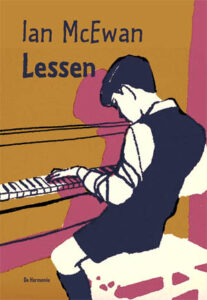
Relevant excerpt from the novel ‘Lessons’ by Ian McEwan
A socio-political novel in which the protagonist is followed against the backdrop of major historical events (De Harmonie).
 He left the galleries with paintings prematurely and waited in the large hall. After she had joined him and they walked away, he burst out. He said that if he had to look at one more Madonna and Child, Crucifixion, Assumption of Mary, Annunciation or any more of that rubbish, he would start ‘vomiting’.
He declared that Christianity had long been the death in the pot for the European imagination. It was a blessing that this tyranny had run its course. All that apparent piety was enforced conformism within a totalitarian mentality. If in the sixteenth century you questioned it or resisted it, you risked your life. It was something like protesting against socialist realism in the Soviet Union under Stalin. Christianity had held not only science but almost the entire culture in a stranglehold for fifty generations, nearly everything related to free expression and critical inquiry. It had buried the unbiased philosophical currents of classical antiquity for an entire epoch and had caused thousands of brilliant minds to waste their energy on senseless theological quibbling. It had spread its so-called Word with horrific violence and maintained itself through torture, persecution, and murder. […]
Within the entirety of human experience of the world, there existed an infinite number of possible subjects, yet across Europe the museums were crammed with the same repulsive kitsch. It was even worse than pop music. It was the Eurovision Song Contest in oil paint and gilded frames. […]
What a relief it was to see an image of a bourgeois interior, of a loaf of bread on a cutting board with a knife beside it, of a couple skating on a frozen canal, hand in hand enjoying a simple pleasure while that godforsaken minister wasn’t watching for a moment. Long live the Dutch!