Maria the Cricket and Martha the Ant
In our society, the value of life is often measured in terms of labor, achievement, and productivity. Those who work are considered virtuous; those who rest are seen as lazy or work-shy. Yet something very essential is missing here. For alongside obligatory tasks, there can exist a deep longing to sing, to listen, to create. A longing to bloom as a flower does—without-more. Without having to produce anything. There is a tension between labor and inspiration, between social pressure and inner freedom, between responsibilities and authentic self-expression. Age-old parables—those of the Cricket and the Ant, and of Mary and Martha—speak of how one can live from the heart, remain faithful to what one cannot “leave undone,” and of care for existence and devotion that must not be lost from sight.
The Cricket and the Ant
The fable in verse about the cricket and the ant by Jean de La Fontaine (originally a fable by Aesop) is moralistic: the ant works hard during summer to store provisions for the coming winter, while the cricket merely sings in the sunshine. Those who do not work shall not eat, the story tells us. Yet between these small creatures lies a deeper tension: between doing and Being, between duty and inspiration, between practical living and the art of living itself.
“I cheer you up a little,” said the cricket. “Come, listen to my song.” She angrily shook her head: “An ant does not laze about!”
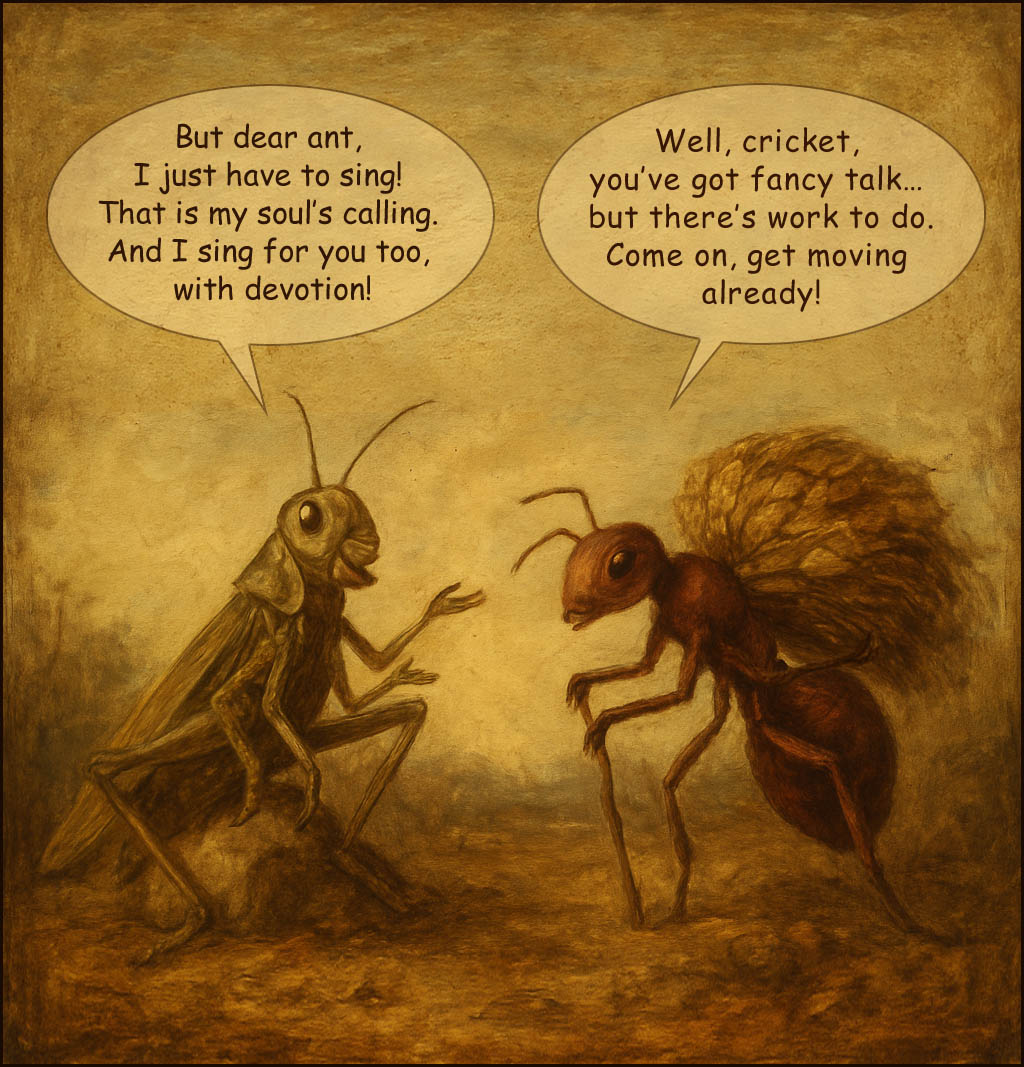 When winter arrives, the cricket has no food and asks the ant for help. The ant, however, refuses and tells him that he should have worked instead of singing.
“What were you doing while the sun still shone, and I was gathering my stores?”
“I sang for you,” the cricket softly replied. “That is something an ant despises!
You sang then, and now you are poor.
So dance now, then you’ll keep warm!”
With the closing lines:
“Whoever lives by art is deemed a fool.
He often suffers hunger and want.”
The cricket is thus left hungry, and the moral is that one must prepare for the future by working, rather than enjoying the Now without thinking of later. A work ethic! Yet in this, Jean de La Fontaine forgets the importance of enjoying the Now—and the importance of art.
Mary and Martha
The Gospel of Luke tells a similar story about Mary and Martha (Luke 10:38–42).
During a journey, Jesus and some of his followers visit the home of the sisters Mary and Martha. Mary chooses to sit at the feet of Jesus and listen to His words, while Martha is busy preparing food for the guests. Martha becomes frustrated and asks Jesus to send Mary to help her. Jesus responds that Martha should not worry and affirms Mary’s choice to listen to His words, saying that she may continue to do so. From another text it appears that Mary also fell rather in love with Jesus—and yes, then you naturally keep listening, especially when your sister has already taken responsibility for the work that needs to be done.
The ant and Martha stand for care, responsibility, duty, and foresight. They symbolize devotion and commitment. The cricket and Mary stand for openness, the singing of the heart, and joy in life, and they symbolize attention and a longing for truth. In an old rhyme (published in the 1960s by the Society of African Missions and at the time illustrated by my mother Toos Koedam), the ideal balance was summarized as follows:
“So the best thing is for me to be called Mary-Martha, for then I listen to You, and the work is not forgotten.”
This is absolutely not a moralistic adage; it is an invitation to authentic living, in which we both take responsibility and remain faithful to what truly moves our soul.
Social layer
In our time, the work ethic can at times be called unhealthy. There are people who, out of necessity or systemic pressure, work in jobs that do not touch their soul in any way. Almost like wage slaves in a society that places productivity above humanity, above self-expression. Modern life, driven by social expectations and financial necessity, forces many into labor that drains them. One is not free.
On the other hand, there are people who live in comfort with little engagement, sometimes because they can live off “old money” and no longer need to work. They choose a frivolous or even hedonistic lifestyle. They appear free, but if the heart does not truly sing, that freedom is an illusion. They too are not free—enslaved by materialism.
Work is most valuable when it arises from one’s own desire to bloom, from an inwardly felt longing or drive that one does not want—or cannot—ignore. For me, that became music. My father showed me this principle at a young age. He told me how he resisted my grandfather’s wish that he attend a business school, because he wanted to become a painter. He wanted to study at the National Academy of Fine Arts. He often said: “It is important to do work that you cannot leave undone.” Truly inspired work, then—not work driven only by necessity. In that way, work can even become a calling.
Spiritual layer
When the dominant societal work ethic is rejected, a subtle pitfall can arise. We see this among people who adhere to a certain kind of spirituality—what I would call a semblance of spirituality that is safe and non-committal. Everything is fine! Nothing is required. Accompanied by the belief that life can be manufactured through “manifesting”—the creation of one’s future through affirmations and visualizations. This became popular (even a craze) with the release of the book The Secret. A pseudo-spiritual form of freedom that avoids responsibility.
We also see people who ignore their own natural longing for growth and meaning and instead strive toward an idealized version of themselves, without genuine contact with their soul’s intention. Many influencers fuel this. Everything is done to remain within a pleasant comfort zone. But true spirituality is not non-committal and does not always offer comfort: it calls for awareness, for the development of consciousness, and for faithfulness to one’s nature and soul potential—even when circumstances are difficult. It calls for intrinsic motivation and discipline, just like the aforementioned Mary-Martha combination that unites listening and Being with the devotion to do what needs to be done.
Existence is in a certain sense
synonymous with being expressive
Blooming as the Goal of Education
The Absolute, God, the Universe—whatever name you choose—has given the human being the possibility to fully bloom in self-expression, independent of utility, possession, or outward success. Just as a daisy blooms (unseen by anyone); or as a galaxy comes to full fruition (unseen by anyone), so human life is meant to allow us to come into full self-expression. To live fully is synonymous with blooming fully, which allows us to experience happiness.
Our ability to bloom in a particular field is largely determined by innate talents and natural affinities. The education of young people should therefore primarily focus on helping them discover and develop their predispositions. Within upbringing and education, this can then take shape in form, content, and level—first and foremost detached from the ‘usefulness’ it is supposed to have. Situations and people encountered along their path can inspire and enthuse them in this process. Hopefully, these present themselves at the right moment, for synchronicity in circumstances plays an essential role. In this way, blooming can be encouraged and realized from an early age—through meaning, enthusiasm, study, and purposeful action that accompanies it. Inner discipline arises naturally when these conditions are present.
When we bloom in pure self-expression, a certain inner unity becomes tangible in our mind: all aspects of thinking, feeling, and doing naturally fall into alignment. Realizing this inner unity naturally leads to a vivid and authentic Being, in a state of flow—whatever the field may be, however hard we may work. This brings happiness. Such unity arises when we come to know ourselves and discover what we are ‘meant’ for. And it naturally requires us to face what within ourselves still obstructs that unity.
Integrating Head and Heart
Life invites us into a delicate dance: acting and listening, working and blooming, care and joy. The cricket teaches us to sing, the ant teaches us to care; Mary teaches us attentive listening, Martha teaches us devoted action. Joy and dedication both arise from the heart. Acting from intrinsic discipline arises from the head, from our intelligence. The art of mature living is to bring all of this into balance: to do what is necessary with devotion and to remain faithful to what you cannot leave undone. Not choosing between these poles, but integrating them. Whoever can do this—who remains true to an inner impulse while also taking responsibility—lives fully. Thus, these principles become a guideline for conscious living, in which work does not remain undone, our heart does not wither, our head is able to lead, and our soul will bloom as the universe intended.